3 Types of ADHD in Adults and What Each Presentation Means
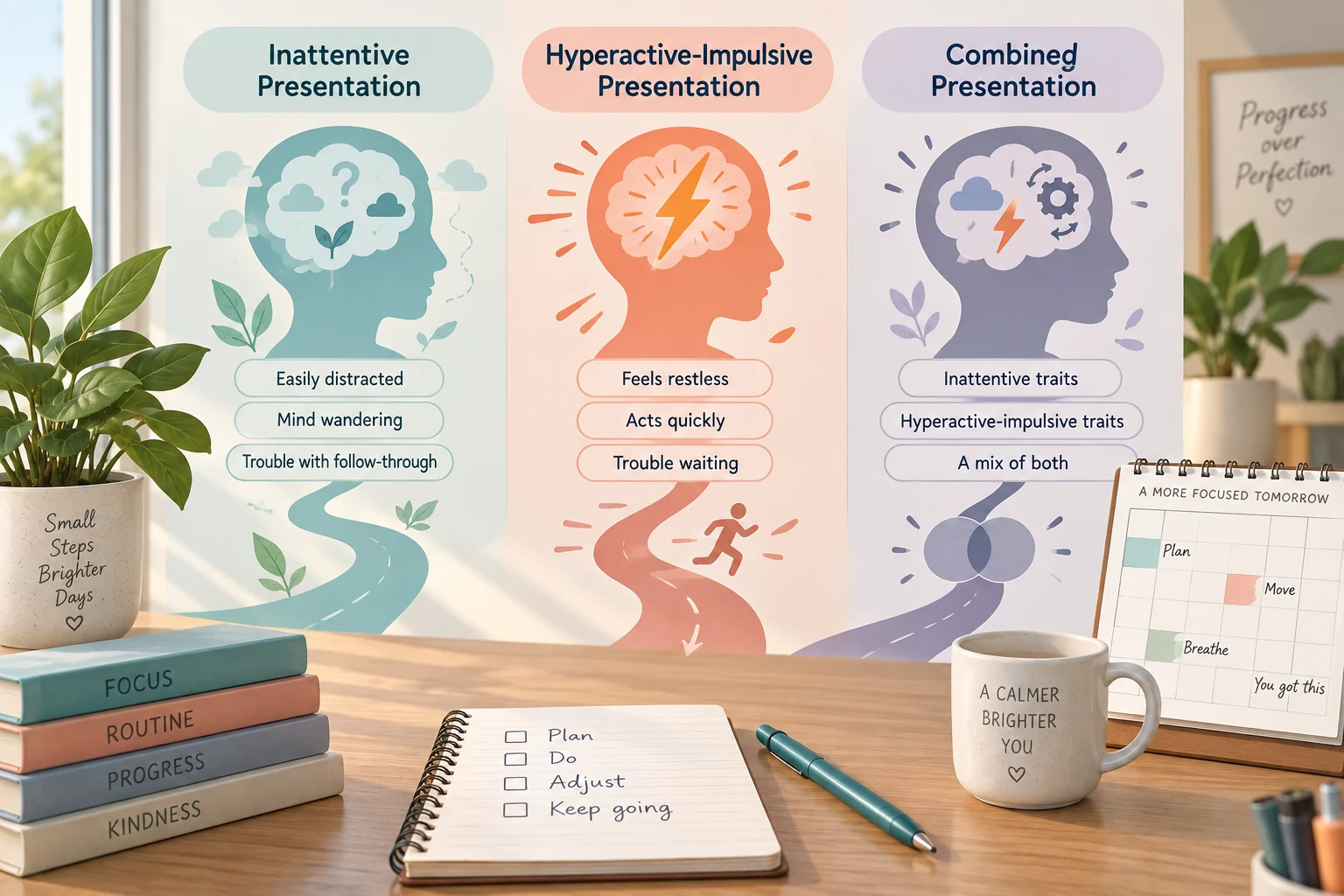
The 3 types of ADHD most people are asking about are better described as three ADHD presentations: predominantly inattentive, predominantly hyperactive-impulsive, and combined. The word "type" is common in everyday searches, but "presentation" is more precise because symptoms can shift with age, setting, stress, support, and life demands.
For adults, this distinction matters because ADHD may look less like obvious childhood hyperactivity and more like lost time, unfinished tasks, restlessness, emotional impatience, missed details, or chronic disorganization. If you are trying to understand your own patterns, an adult ADHD self-reflection tool can be a low-pressure way to organize what you notice before deciding whether to discuss it with a qualified professional.
What "Type" Means in ADHD
ADHD stands for attention-deficit/hyperactivity disorder. The name can be misleading because ADHD is not only about attention and not always about visible hyperactivity. It involves patterns of inattention, hyperactivity, and impulsivity that are more persistent and impairing than ordinary distraction or occasional procrastination.
In current clinical language, the 3 types of ADHD are usually framed as presentations rather than fixed identities. A presentation describes which symptom group is most visible at a given time. One adult may mainly struggle with organization and follow-through. Another may feel driven by restlessness or quick reactions. A third may experience both clusters strongly enough that the combined presentation fits best.
This is also why older language such as ADD can cause confusion. ADD was once widely used for attention problems without obvious hyperactivity, but ADHD is now the broader term. When people search for "ADD vs ADHD," they are often asking whether inattentive ADHD can exist without the classic image of a constantly moving child. The answer is yes: inattention can be central, especially in adults.
The 3 Types of ADHD in Adults
Predominantly Inattentive Presentation
Predominantly inattentive ADHD is often associated with difficulty sustaining attention, organizing tasks, following through, remembering details, or managing time. In adults, this may show up as missing parts of conversations, losing track of work steps, forgetting appointments, underestimating how long tasks will take, or needing unusual effort to begin and finish routine responsibilities.
This does not mean the person never pays attention. Many adults with inattentive patterns can focus intensely on high-interest or urgent tasks. The difficulty is often regulating attention on demand, especially when a task is repetitive, unclear, delayed in reward, or mentally crowded.
Because inattentive ADHD can look quiet from the outside, it may be mistaken for laziness, lack of care, anxiety, burnout, or poor discipline. Those possibilities can overlap, which is one reason professional evaluation is important when symptoms are persistent and disruptive.
Predominantly Hyperactive-Impulsive Presentation
Predominantly hyperactive-impulsive ADHD centers on restlessness, excessive movement or talking, quick decisions, interrupting, difficulty waiting, or acting before fully considering consequences. In adults, hyperactivity may become internal. Instead of running or climbing, a person may feel constantly "on," switch tasks rapidly, seek stimulation, fidget during meetings, or feel uncomfortable with slow processes.
Impulsivity can affect conversations, spending, driving, conflict, or work decisions. It can also appear as emotional urgency: sending a message too quickly, jumping into commitments, or reacting before there is enough time to pause. The key is not one impulsive moment, but a repeated pattern that causes problems across settings.
Combined Type ADHD
Combined type ADHD means both inattentive and hyperactive-impulsive symptom clusters are prominent. This is the presentation many people imagine when they think of ADHD, but it is not the only valid pattern. In adults, combined ADHD may involve both unfinished work and restless overcommitment, both distractibility and interrupting, both disorganization and difficulty slowing down.
An ASRS-based ADHD screening starting point may help adults put these mixed patterns into words. Screening is not the same as an evaluation, but it can make a later conversation more specific by turning vague concerns into a clearer list of experiences.

Why You May See 7, 9, or 12 ADHD Types Online
Search results often include phrases like "7 types of ADHD in adults," "9 types of ADHD," "12 types of ADHD," "ADHD type A," or "type 4 ADHD." These can refer to popular frameworks, coaching models, personality-style labels, or research discussions. They may be useful as informal ways to talk about experience, but they should not be confused with the standard three-presentation framework.
There is also ongoing research into ADHD heterogeneity. Some newer studies explore whether brain imaging, cognitive profiles, or developmental patterns can identify meaningful subgroups. That research is interesting, but it does not mean a person can use a headline, scan image, or online article to assign themselves a new clinical category. For everyday education and care conversations, the three presentations remain the clearest starting point.
The practical question is not "Which internet type am I?" It is: which patterns are causing difficulty, where do they appear, how long have they been present, and what support would reduce the impact?
How the Presentations Can Look Different in Adults
Adult ADHD often becomes visible when demands exceed the systems a person has built. A student who once relied on deadlines may struggle after entering a less structured job. A parent may notice symptoms after sleep disruption, multitasking, or household management increases. A high-performing professional may function well in public while privately spending enormous energy recovering from disorganization.
The 3 types of ADHD in adults can also blend with anxiety, depression, sleep problems, substance use, trauma history, learning differences, or autism spectrum traits. ADHD is not a form of autism, but the two can co-occur and share some visible features, such as difficulty with attention regulation or transitions. Sorting out the difference requires attention to developmental history, social communication, sensory patterns, repetitive behaviors, and the full context of functioning.
This is why a single symptom list is not enough. Many people procrastinate. Many people fidget. Many people forget names or misplace keys. ADHD becomes a stronger concern when patterns are persistent, began earlier in life, show up in more than one setting, and interfere with daily responsibilities or relationships.
A Simple Reflection Checklist
Use these prompts as a way to organize your thinking, not as proof of ADHD:
- Which problems are most common: losing focus, feeling restless, acting too quickly, or a mix?
- Do these patterns appear at work, at home, in relationships, and during routine tasks?
- Were similar patterns present earlier in life, even if they were managed or hidden?
- What helps: structure, reminders, body movement, shorter tasks, external accountability, or fewer distractions?
- What still causes problems even when motivation is high?
- Have sleep, stress, anxiety, depression, medication, substances, or major life changes affected the pattern?

A Calm Next Step After Reading About ADHD Types
Learning about the 3 types of ADHD can make scattered experiences feel more organized, but it should not pressure you into a label. The most useful next step is usually documentation: write down examples, settings, frequency, what helps, and what gets in the way.
If you want a private way to structure that reflection, the free adult ADHD screening starting point can help you review common adult ADHD indicators. Treat the result as educational information, not a final answer. If your patterns are persistent, distressing, or affecting work, school, relationships, safety, or daily care, consider discussing them with a qualified clinician who can look at the whole picture.
FAQ
Are there three types of ADHD?
Yes. In common language, people often say there are three types of ADHD: predominantly inattentive, predominantly hyperactive-impulsive, and combined. More precise clinical language often calls them presentations because the visible pattern can change over time.
What is ADHD inattentive type?
ADHD inattentive type refers to a pattern where attention regulation, organization, follow-through, forgetfulness, and distractibility are the most prominent concerns. In adults, it can look like chronic task delays, missed details, time-management problems, or mental drifting rather than obvious disruptive behavior.
What is combined type ADHD?
Combined type ADHD means inattentive symptoms and hyperactive-impulsive symptoms are both prominent. An adult with combined patterns might struggle with planning and completion while also feeling restless, interrupting, switching tasks quickly, or making rushed decisions.
What is type 4 ADHD?
"Type 4 ADHD" is not part of the standard three-presentation framework. It usually comes from alternative models, coaching language, or popular explanations. Those labels may describe experiences, but they should not replace careful evaluation by a qualified professional.
What is the rarest ADHD type?
The answer can vary by age group, sample, and how symptoms are measured. In many adult discussions, predominantly hyperactive-impulsive presentation is treated as less common than inattentive or combined patterns, but rarity is less important than whether symptoms are persistent and impairing.
Is ADHD a form of autism?
No. ADHD and autism are distinct neurodevelopmental conditions, although they can co-occur and sometimes share visible features such as attention differences, restlessness, sensory overwhelm, or difficulty with transitions. A professional evaluation can help separate overlapping patterns.
Is ADD different from ADHD?
ADD is an older term that many people still use for attention problems without obvious hyperactivity. Today, ADHD is the broader term, and the closest current description is usually predominantly inattentive presentation.