ASRS Test Accuracy: What Do Your Results Really Mean?
The Adult ADHD Self-Report Scale (ASRS) is a trusted starting point for millions of adults exploring their attention patterns. It's an accessible tool endorsed by the World Health Organization (WHO) for initial screening. But after you answer the questions and get a score, a bigger question often arises: How much can I trust these results?
Understanding the accuracy of any screening tool is essential. It helps you see the results for what they are: a valuable piece of information, not a final diagnosis. In this article, we'll demystify the science behind the ASRS test's reliability. We'll explore its statistical foundations, clinical validation, and how you can interpret your score responsibly. This knowledge will empower you to use tools like our free ASRS test with confidence and clarity.
Understanding ASRS Test Reliability: The Statistical Foundations
To grasp the accuracy of the ASRS ADHD test, we need to look at two key concepts in medical screening: sensitivity and specificity. These terms sound technical, but they simply describe how well a test can identify people who have a condition and those who do not.
A good screening tool must balance these two factors. If it's too sensitive, it might flag people who don't have ADHD. If it's too specific, it might miss people who do. The ASRS was carefully designed to find a reliable middle ground, making it a powerful first step in the assessment process.
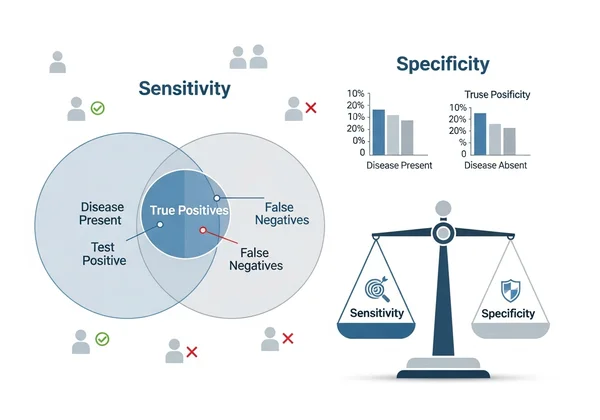
Sensitivity vs Specificity in ADHD Screening
In simple terms, sensitivity measures how well a test correctly identifies individuals with a condition. For an ADHD screening, high sensitivity means the test is good at catching most cases of potential ADHD. It answers the question: "Of all the people who truly have ADHD, what percentage will test positive?"
On the other hand, specificity measures how well a test correctly identifies individuals without the condition. High specificity means the test is good at ruling out ADHD in people who do not have it. It answers the question: "Of all the people who do not have ADHD, what percentage will test negative?" The ASRS test has been studied extensively to ensure it performs well on both fronts.
What False Positives and False Negatives Mean for Your Results
No screening tool is perfect, and that's where the ideas of "false positives" and "false negatives" come in.
- A false positive occurs when the test suggests you might have ADHD, but you actually don't. This can happen if symptoms of other conditions, like anxiety or stress, overlap with ADHD symptoms.
- A false negative occurs when the test suggests you do not have ADHD, but you actually do. This might happen if an individual's symptoms present in a less typical way or if they have developed strong coping mechanisms that mask their difficulties.
Understanding this helps you see your ASRS results as a guide. A score suggesting ADHD warrants a conversation with a professional, not a self-diagnosis. Likewise, a lower score doesn't completely rule out ADHD if you still have significant concerns. The goal is to gather information, and taking an online ADHD screening is an excellent way to start.
Clinical Validation Studies Behind the ASRS v1.1
The credibility of the ASRS test isn't based on opinion—it's built on rigorous scientific research. The version used in most clinical settings, ASRS v1.1, was developed through a collaboration between the World Health Organization and Harvard Medical School researchers. This partnership ensured the scale was both scientifically sound and practically useful.
These validation studies are crucial for establishing trust. They confirm that the questions asked are relevant, the scoring system is meaningful, and the results are consistent. This evidence is why healthcare professionals worldwide use the ASRS as a reliable screening instrument.

WHO and Harvard Research Findings
The foundational research for the ASRS v1.1 involved testing its questions on large, diverse populations. Researchers compared the ASRS scores of individuals already diagnosed with ADHD by clinicians to the scores of people in the general population. The findings, published in peer-reviewed journals, demonstrated that the ASRS v1.1 is a valid and reliable tool for identifying adults who may have ADHD.
The research confirmed that the 18 questions effectively capture the core symptoms of inattention and hyperactivity/impulsivity as defined in official diagnostic criteria. This strong backing from institutions like WHO and Harvard is a key reason why you can feel confident using this scale as a preliminary step. When you are ready to explore these questions for yourself, you can start your test here.
Cross-Cultural Reliability Across 15+ Languages
ADHD is a global condition, so a good screening tool must be reliable across different cultures and languages. The ASRS has been translated and validated in numerous languages, including the 15+ languages available on our platform.
Studies have shown that the ASRS maintains its psychometric properties—its reliability and validity—in different cultural contexts. This means the test works well whether you are taking it in English, Spanish, Japanese, or Arabic. This cross-cultural validation ensures that people around the world have access to a consistent and trustworthy method for self-screening, removing language as a barrier to understanding one's mental health.
Interpreting Your ASRS Score: What the Numbers Actually Mean
After completing the 18 questions, you receive a score. This number provides a snapshot of your recent experiences with symptoms related to ADHD. But what does it actually signify? It’s important to remember that the score is not a label or a diagnosis. Instead, it’s a data point that indicates whether your symptoms are consistent with those commonly seen in adults with ADHD.
The ASRS is divided into two parts. Part A consists of the first six questions, which are considered the most critical indicators. Part B includes the remaining twelve questions, which provide additional context about your symptoms. A higher score suggests a higher likelihood that you are experiencing significant ADHD-related challenges.
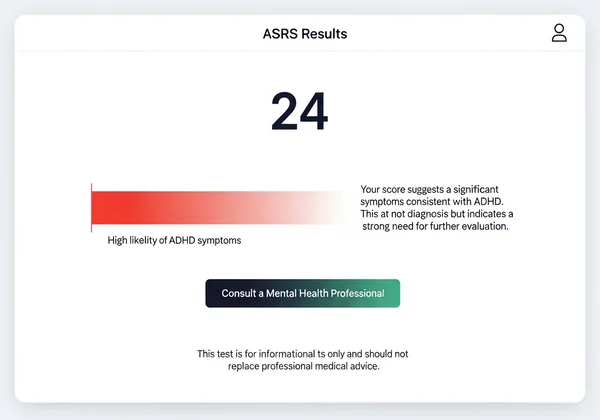
Score Thresholds and Clinical Significance
The ASRS v1.1 uses a scoring system where certain responses in Part A are shaded. If you check four or more of these shaded boxes, it indicates your symptoms may be highly consistent with adult ADHD. This threshold was determined through research as the point that best separates individuals with and without a clinical ADHD diagnosis.
A score above this threshold has clinical significance, meaning it's a strong indicator that a professional evaluation would be beneficial. It provides a concrete reason to talk to a doctor or therapist. However, falling below the threshold doesn't automatically mean you don't have ADHD, especially if you still face daily struggles with focus, organization, or impulsivity. Your personal experience is always the most important factor.
When and How Often to Retest for Meaningful Comparison
The ASRS test reflects your symptoms over the past six months. Since life circumstances, stress levels, and coping strategies can change, your symptoms might change too. For this reason, some people find it helpful to retake the test periodically.
For example, you might retake it after starting a new job, beginning therapy, or implementing new organizational strategies. This can help you track your progress and see if your efforts are making a difference. However, avoid retesting too frequently (e.g., daily or weekly), as this won't provide a meaningful comparison. A good rule of thumb is to wait at least a few months between tests to see if there have been any significant changes in your patterns.
Beyond the Numbers: Using ASRS Results Responsibly
Decades of research from institutions like the World Health Organization and Harvard University confirm that the ASRS test delivers reliable insights you can trust. It offers a scientifically validated way to explore whether your struggles with attention, organization, and impulsivity align with the symptoms of adult ADHD. When you understand what sensitivity and specificity mean, you'll be able to interpret your ASRS score with greater confidence and clarity.
Your score is not a final verdict. It is a starting point for self-awareness and a powerful conversation starter with a healthcare professional. It provides a structured way to present your concerns, backed by a globally recognized standard.
If you've been wondering about your own attention patterns, taking a screening test is a proactive and responsible first step. Our platform offers a confidential way to complete the ASRS and receive an instant AI-powered report to help you understand your results better. Ready to gain clarity? Take the ASRS test now.
The Takeaway
What does ASRS test for and how accurate is it?
The ASRS tests for symptoms of Attention-Deficit/Hyperactivity Disorder (ADHD) in adults aged 18 and older. It assesses patterns of inattention and hyperactivity/impulsivity based on the diagnostic criteria used by clinicians. Research has shown it to be a highly accurate screening tool, meaning it is very effective at identifying adults who should seek a formal diagnostic evaluation from a healthcare professional.
How reliable is the ASRS for detecting ADHD in adults?
The ASRS is considered a very reliable instrument. Its reliability has been confirmed in numerous validation studies conducted by researchers at the World Health Organization (WHO) and Harvard University. It demonstrates high consistency in identifying symptoms that are clinically significant for adult ADHD across diverse populations and languages, making it a trusted first step in the assessment journey.
What influences false positive results in ASRS screening?
False positive results can be influenced by several factors. Conditions like anxiety, depression, burnout, or even high levels of stress can cause symptoms that overlap with ADHD, such as difficulty concentrating or feeling restless. A person experiencing these conditions might score high on the ASRS without having ADHD. This is why a screening result always needs to be discussed with a professional who can consider the full context.
Can I trust my ASRS results without professional evaluation?
You can trust your ASRS results as a reliable indicator of whether a professional evaluation is a good idea. However, the test is not a diagnostic tool and cannot replace the comprehensive assessment provided by a qualified doctor, psychologist, or psychiatrist. You should use the results as a guide for self-understanding and as a tool to facilitate a productive conversation with a healthcare provider. If you're ready to gather this valuable information, you can try our free tool.
How does the ASRS compare to other ADHD assessment tools?
The ASRS is one of the most widely used and respected screening tools for adult ADHD. While other tools exist, the ASRS v1.1 is unique due to its development in partnership with the WHO and its extensive validation. It is often used alongside other methods in a full diagnostic workup, such as clinical interviews, behavior rating scales, and a review of personal history. Its strength lies in its accessibility, speed, and proven accuracy as a preliminary screener.