Types of ADHD — Key Differences You Should Know
If you've ever searched "types of ADHD," you probably noticed a confusing mix of answers. Some sources say three, others mention seven, and a few still use the term ADD. That confusion can make self-understanding feel harder than it should be. This guide breaks down the officially recognized types of ADHD, explains how each one shows up in real life — especially for adults — and clears up common misconceptions. You'll also find a self-reflection section, practical next steps, and a short FAQ. Whether you're exploring ADHD for yourself or someone you care about, you can also explore the ASRS self-screening tool as a starting point.
What Are the Three Recognized Types of ADHD?
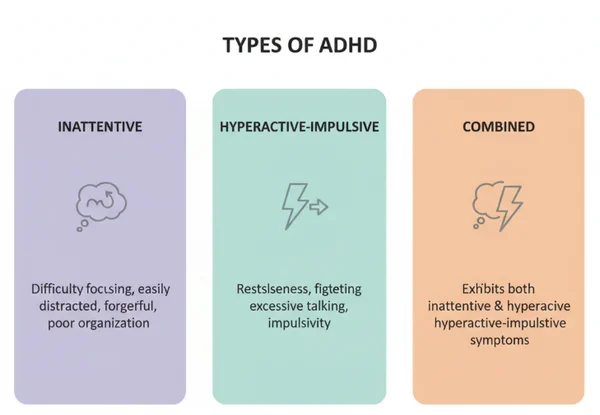
ADHD is not a single experience. According to the DSM-5 — the standard reference used by clinicians worldwide — there are three recognized presentations of ADHD. Each one describes a different pattern of symptoms, and understanding these patterns can help you make sense of your own experience or that of someone close to you.
How the DSM-5 Defines ADHD Presentations
The Diagnostic and Statistical Manual of Mental Disorders, Fifth Edition (DSM-5), classifies ADHD into three presentations based on which symptoms are most prominent:
- Predominantly Inattentive Presentation — difficulty sustaining focus, staying organized, and following through on tasks.
- Predominantly Hyperactive-Impulsive Presentation — restlessness, excessive talking, difficulty waiting, and acting without thinking.
- Combined Presentation — a significant mix of both inattentive and hyperactive-impulsive symptoms.
These are not permanent labels. Your presentation can shift over time depending on life stage, environment, and coping strategies. Think of them as a snapshot of how ADHD shows up for you right now.
Why Experts Stopped Using the Term ADD
You might still hear people say "ADD" when referring to the inattentive type. However, the medical community officially retired the term ADD in 2013. Today, all forms fall under the umbrella of ADHD — with the specific presentation noted afterward. So what was once called ADD is now referred to as "ADHD, predominantly inattentive presentation." This change helps reduce confusion and ensures that all three types of ADHD are recognized as part of the same condition.
What Does Predominantly Inattentive ADHD Look Like?
Inattentive ADHD is often the quietest type — and that's exactly why it gets missed. People with this presentation may not seem restless or impulsive. Instead, their struggles tend to happen internally: losing track of conversations, forgetting appointments, or feeling mentally foggy even during important tasks.
Common Signs of Inattentive ADHD in Everyday Life
Here are some patterns that often show up with this type:
- Frequently losing personal items like keys, wallets, or phones
- Difficulty following multi-step instructions at work or home
- Starting projects with enthusiasm but struggling to finish them
- Zoning out during meetings or conversations, even when you want to pay attention
- Avoiding paperwork, long emails, or tasks that require sustained focus
- Making careless mistakes despite understanding the material
These signs might look like laziness or disinterest on the surface. In reality, they often reflect a neurological pattern — not a character flaw.
Why This Type Often Goes Unnoticed in Adults
Inattentive ADHD tends to fly under the radar because it doesn't disrupt others. In school, the child who stares out the window draws less attention than the one who can't sit still. As adults, people with inattentive ADHD may have developed strong compensatory strategies — detailed to-do lists, extra reminders, working late to catch up. These workarounds can mask the underlying difficulty for years.
Women and girls are especially likely to be underdiagnosed with this type, partly because the clinical research historically focused on boys exhibiting hyperactive behaviors.

How Hyperactive-Impulsive ADHD Shows Up in Daily Life
When most people picture ADHD, they imagine a child bouncing off the walls. That image comes from the hyperactive-impulsive presentation — but the reality in adulthood looks very different.
Recognizable Symptoms Beyond Childhood Restlessness
In children, hyperactivity might mean running, climbing, or being unable to sit through class. In adults, it typically shows up as:
- An internal sense of restlessness or feeling "driven by a motor"
- Talking excessively or dominating conversations without realizing it
- Difficulty relaxing or sitting through a movie, dinner, or meeting
- Fidgeting with hands, tapping feet, or constantly shifting positions
- Taking on too many tasks at once because slowing down feels impossible
The physical hyperactivity often decreases with age, but the inner restlessness can persist well into adulthood.
How Impulsivity Looks Different in Adults
Impulsivity in adults goes beyond blurting out answers. It can affect daily decisions in meaningful ways:
- Making impulsive purchases or financial decisions
- Interrupting others frequently during conversation
- Reacting emotionally before fully processing a situation
- Quitting jobs, relationships, or commitments on a sudden impulse
- Difficulty waiting in line, in traffic, or for a response
These behaviors can strain relationships and careers — but they often stem from differences in how the brain processes reward and delay, not from a lack of caring.
Why Combined Type ADHD Is the Most Common Presentation
Combined presentation is exactly what it sounds like: a blend of both inattentive and hyperactive-impulsive symptoms. It's also the most frequently diagnosed type of ADHD across all age groups.
How Inattentive and Hyperactive Symptoms Overlap
People with combined type may find themselves switching between extremes. One moment, they're hyperfocused on something exciting. The next, they can't bring themselves to start a mundane task. They might struggle with both focus and impulse control, which can make daily life feel unpredictable.
To meet the criteria for combined presentation, a person typically needs to show at least five or six symptoms from both the inattentive and hyperactive-impulsive categories.
What Daily Life Looks Like With Combined ADHD
Here's how combined type might show up in a typical day:
- Forgetting a morning meeting (inattentive) and then impulsively rescheduling three others to compensate (impulsive)
- Starting a work project with intensity (hyperactive) but losing interest midway (inattentive)
- Feeling mentally scattered while also physically unable to sit still during a conversation
Because combined type covers a broader range of symptoms, it's often easier for clinicians to identify — though it can also feel more overwhelming for the person experiencing it.
How Types of ADHD Show Up Differently in Adults
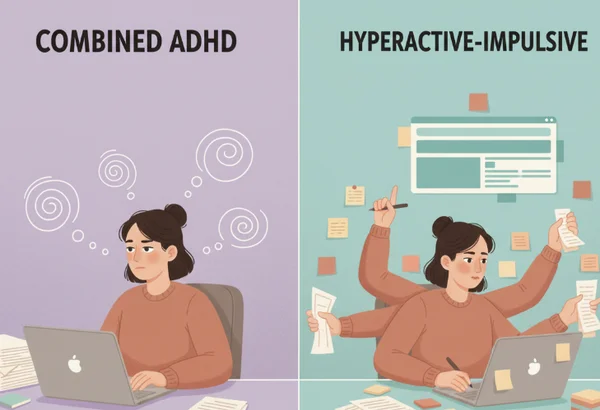
ADHD doesn't disappear when you turn 18. For many adults, symptoms simply shape-shift. Understanding how the different types of ADHD evolve with age is essential — especially if you're only starting to explore this now.
Symptoms That Shift With Age
The physical hyperactivity that's obvious in childhood often transforms into internal restlessness in adulthood. Meanwhile, inattentive symptoms may become more noticeable as life demands grow — managing a household, meeting work deadlines, maintaining relationships.
Common adult-specific patterns include:
- Chronic lateness and time blindness
- Emotional dysregulation — overreacting to small setbacks or feeling overwhelmed quickly
- Difficulty with executive function tasks like planning, prioritizing, and following through
- Relying heavily on caffeine or stimulation to stay engaged
Why Late Recognition Happens More Than You Think
Many adults with ADHD were never evaluated as children. Some were told they were "smart but lazy." Others masked their symptoms with sheer effort, especially women and individuals from communities where ADHD awareness was low.
Late recognition doesn't mean late onset. It usually means the signs were always there — just misunderstood. If this resonates with you, that awareness alone can be a meaningful step forward.
Can Your ADHD Type Change Over Time?
Yes — and this is important to understand. ADHD presentations are not fixed. The DSM-5 uses the word "presentation" intentionally, because the dominant symptom pattern can shift as your brain, environment, and coping strategies evolve.
For example, a child diagnosed with combined type may present primarily as inattentive by adulthood if their hyperactive symptoms decrease. Similarly, someone who appeared mainly inattentive may start showing more impulsive traits under prolonged stress.
This is why clinicians sometimes reassess ADHD presentations over time. Your "type" is a description of your current symptom pattern — not a permanent identity. What matters most is understanding how ADHD affects you right now, so you can seek the support that fits your situation.
What About the "7 Types of ADHD"?
If you've come across the idea of "7 types of ADHD," you're not alone — it's a popular concept. This classification was proposed by Dr. Daniel Amen, a psychiatrist who uses brain SPECT imaging to categorize ADHD into seven subtypes, including "overfocused," "temporal lobe," and "limbic" ADHD.
However, this model is not recognized by the DSM-5 or by major medical organizations like the CDC, NIH, or the American Psychiatric Association. The scientific consensus remains that there are three official presentations.
That doesn't mean the "7 types" framework is worthless. Some people find it helpful for personal reflection. But it's important to know that it lacks the peer-reviewed validation required for clinical use. If you encounter this idea, treat it as one perspective — not an established diagnostic standard.
When exploring how ADHD affects your daily life, evidence-based frameworks tend to offer more reliable guidance.
How to Explore Which ADHD Pattern Fits You
At this point, you may see yourself in one — or more — of the types of ADHD described above. That's a meaningful observation. However, self-awareness is just the beginning. Turning that awareness into useful next steps is what really matters.
Why Self-Reflection Is a Helpful First Step
Before seeking a formal assessment, it can be helpful to organize your observations. Try asking yourself:
- Which symptoms feel most familiar to me — difficulty focusing, restlessness, or both?
- When did I first start noticing these patterns — childhood, college, a new job?
- How are these patterns affecting my work, relationships, or daily routines?
Writing down your answers can give you clarity and help you communicate more effectively if you choose to speak with a professional.
What a Screening Tool Can (and Can't) Tell You
A standardized screening tool like the ASRS (Adult ADHD Self-Report Scale) can help you identify attention-related patterns in a structured way. Developed in collaboration with the World Health Organization, the ASRS is widely used as a preliminary self-check.
What it can do:
- Help you organize and articulate your experiences
- Highlight patterns you might not have noticed
- Provide a starting point for a conversation with a healthcare provider
What it cannot do:
- Diagnose ADHD
- Replace a professional clinical evaluation
- Tell you which specific type of ADHD you have with certainty
This screening tool is designed for self-reflection and education — not for diagnosis. If your results suggest attention-related patterns, consider discussing them with a qualified professional.
Key Takeaways About the Different Types of ADHD
Understanding the types of ADHD is about more than labels. It's about recognizing patterns, removing self-blame, and taking informed next steps. Here are the essential points to carry with you:
- There are three recognized ADHD presentations: inattentive, hyperactive-impulsive, and combined.
- Your presentation can change over time — it's a current snapshot, not a permanent identity.
- Adults often experience ADHD differently than children — internal restlessness, emotional reactions, and executive function struggles are common.
- The "7 types of ADHD" concept is popular but not clinically validated.
- Self-screening tools like the ASRS can help you organize your observations, but they don't replace professional evaluation.
- If ADHD symptoms are affecting your daily life, speaking with a healthcare provider is a worthwhile next step.
Whatever type of ADHD resonates with your experience, you deserve support that fits your needs. A structured self-check like the ASRS screening tool can be a gentle way to begin that process.
Frequently Asked Questions
What is the rarest type of ADHD?
The predominantly hyperactive-impulsive presentation is the least common among adults. Most people with ADHD show either inattentive or combined patterns, especially as hyperactive symptoms tend to decrease with age.
What type of ADHD is most common?
Combined presentation is the most frequently diagnosed type of ADHD. It includes symptoms from both the inattentive and hyperactive-impulsive categories, which makes it easier for clinicians to identify.
What is the difference between ADD and ADHD?
ADD is an outdated term that once referred to the inattentive type. Since 2013, all forms are classified under ADHD, with the specific presentation (inattentive, hyperactive-impulsive, or combined) noted separately.
What does ADHD look like in adults?
In adults, ADHD often appears as chronic disorganization, time blindness, emotional reactivity, difficulty finishing tasks, and internal restlessness rather than visible hyperactivity.
When should someone consider a professional ADHD evaluation?
Consider seeking evaluation if attention-related patterns consistently interfere with your work, relationships, or daily functioning — and if self-help strategies alone haven't addressed those difficulties.
How is ADHD officially diagnosed?
ADHD is diagnosed through a clinical evaluation that includes a detailed history, symptom assessment, and ruling out other possible causes. Screening tools like the ASRS may be used as part of the process but are not diagnostic on their own.